06.10.2019
In collaboration with MVRDV, OUD+Architects won the international competition for the design of the new Kosovo Opera and Music House in Prishtina. Conceived as both a cultural institution and a civic catalyst, the project positions architecture as an active participant in the social, cultural, and urban life of a young country.
The Opera and Music House is envisioned as a place of encounter—where listening, improvisation, contemplation, and celebration coexist. Beyond its technical role of hosting music, dance, and performance, the building proposes a spatial framework that encourages gathering, exchange, and everyday presence. It is imagined not only as a destination to attend, but as a place to inhabit: a setting in which cultural production and social life unfold simultaneously. In this sense, the building aspires to become a musical and social instrument—an architecture that actively produces culture rather than merely containing it.
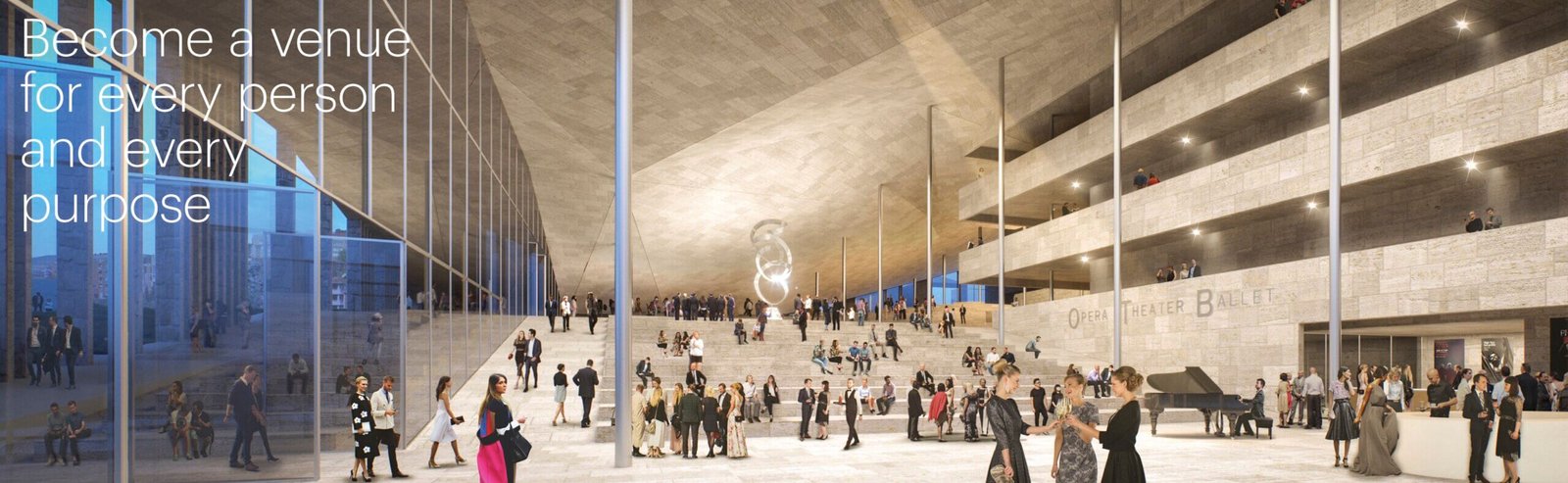
In Prishtina’s new National Opera and Theater, function, building, and landscape are inseparable. Landscape becomes theater, and theater becomes landscape. The traditional separation between public space and performance is deliberately dissolved: the foyer doubles as a performance space; rehearsal rooms function simultaneously as clubs, classrooms, and cafés; and the public plaza operates as both café terrace and open-air stage. Performance is no longer confined to a single room, but is able to emerge anywhere, at any time. Every part of the building is conceived as a potential stage.
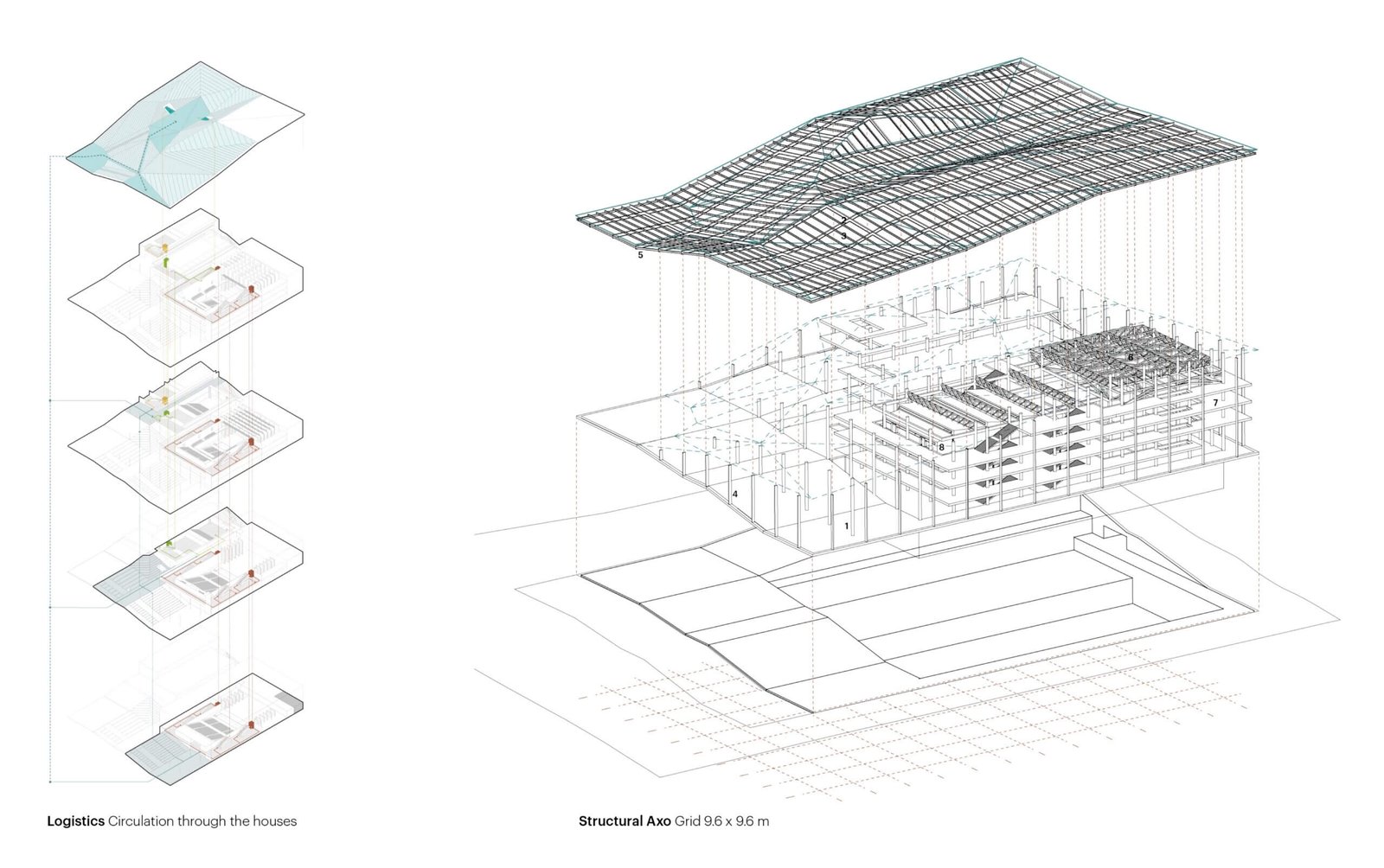
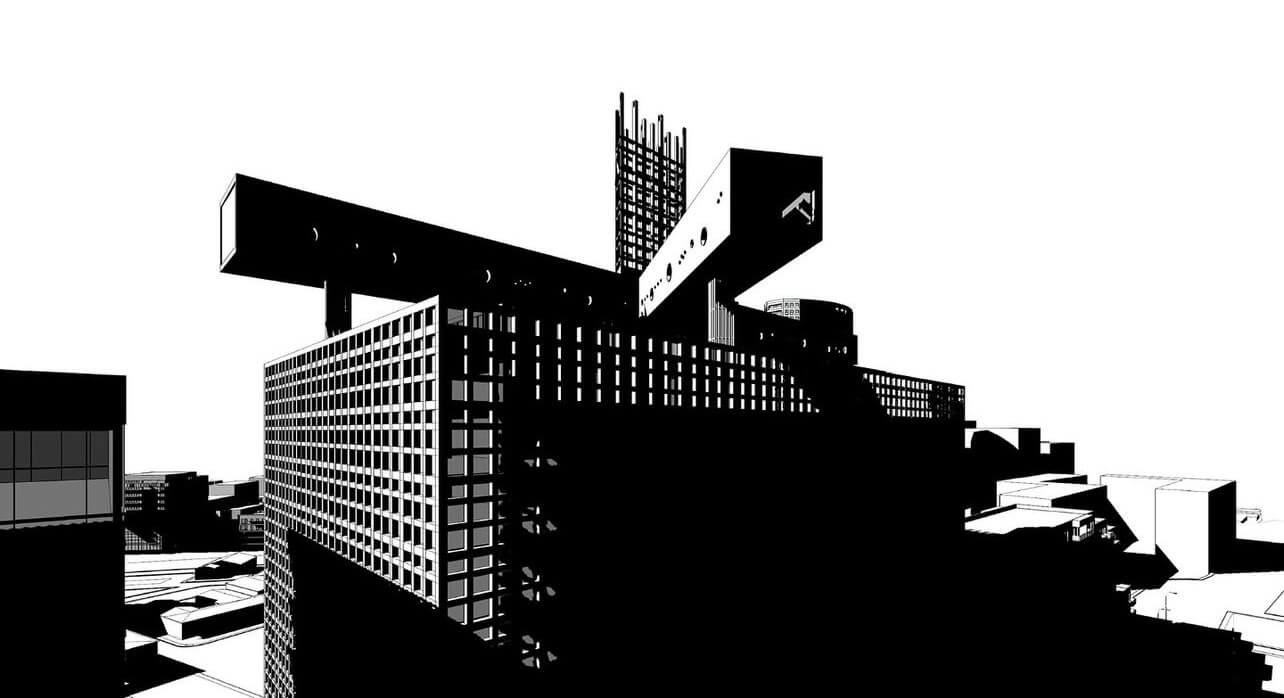
At the core of the complex are three independent “houses”: the Support House, the Rehearsal House, and the Theater House. Each is conceived as a clearly defined and optimized volume, combining orientation, function, and cost efficiency. Their independence guarantees optimal and uninterrupted acoustic conditions, allowing simultaneous use without interference.
These volumes are arranged as a linear “barcode” along the eastern edge of the site. This organizational strategy consolidates technical and programmatic requirements while freeing the western side of the plot to form a large, collective public foyer—the primary civic interface of the building. A secondary entrance foyer for performers and staff is discreetly positioned on the eastern side, behind the rehearsal house, ensuring a clear separation between public and backstage functions.
The Opera and Music House is fully integrated into the city’s movement networks and designed to be accessible to all. Visitors approach the building from surrounding streets and can enter the foyer from multiple points: from Agim Ramadani Street at the highest level, from the new plaza and urban loggia on the west, and from the valley on the south. Taxi and bus drop-offs are located on the northern side of the complex.
Bicycle parking is provided both at plaza level and below ground, while car parking is accommodated underground with access from Fatos Limani Street. All public areas are naturally accessible to wheelchair users and people with differing abilities. Logistics and loading are located along the southern street on the eastern side of the building, concealed from public spaces to ensure efficient operation while maintaining a clear spatial hierarchy between public, performative, and technical realms.
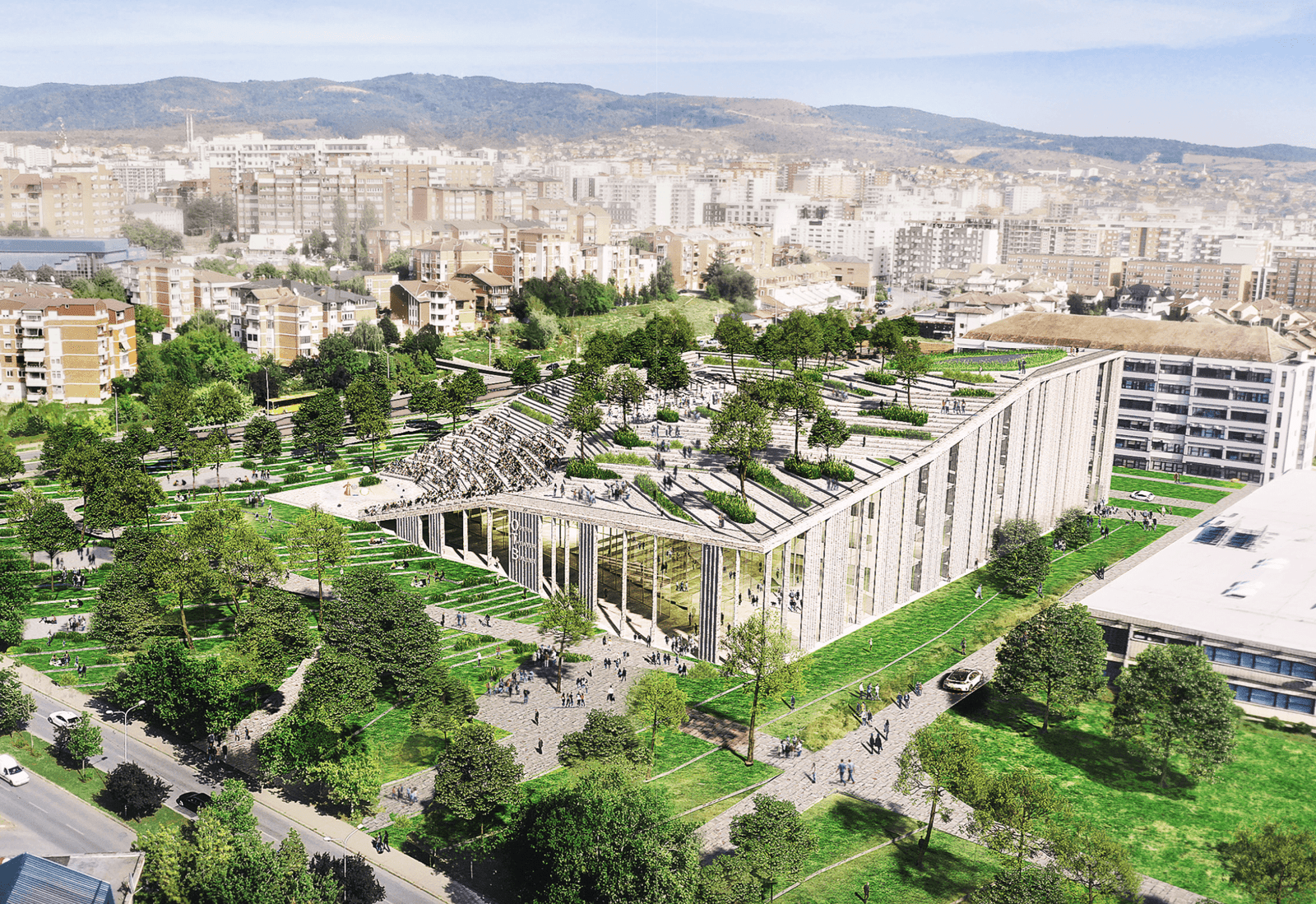
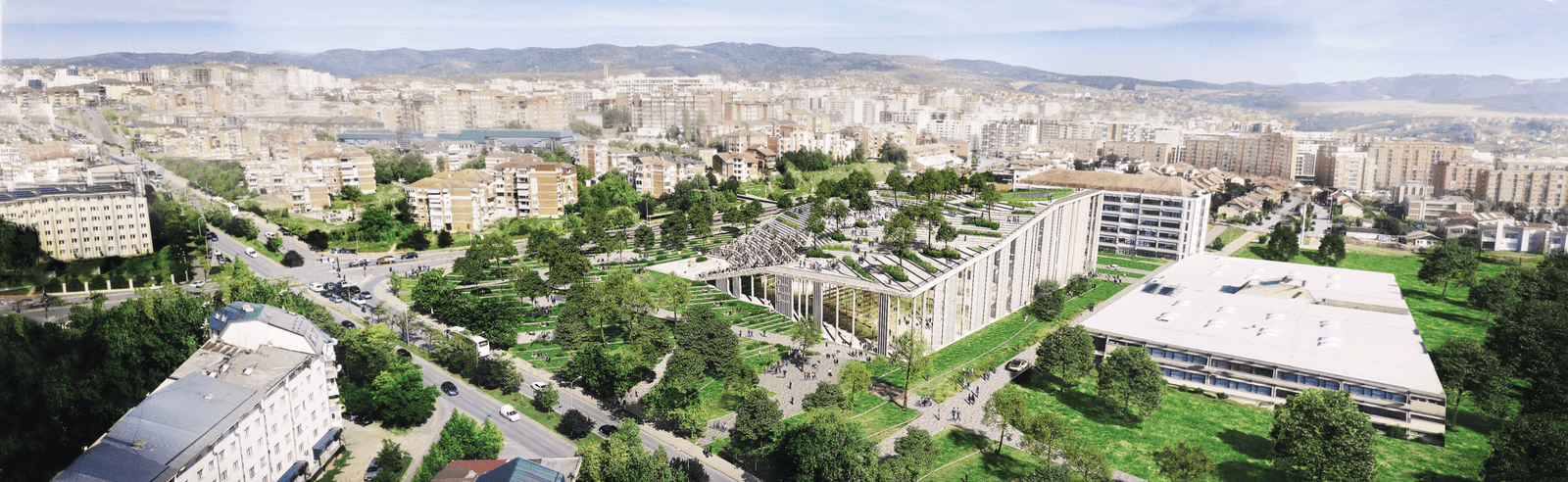
Rather than appearing as a singular object, the Opera and Music House is conceived as a new urban topography—a mountain emerging within the city landscape. The building rises gradually, inviting occupation, movement, and encounter. Architecture is understood here as terrain: something to be climbed, crossed, and inhabited as part of everyday urban life.
This new civic “hill” forms a destination within Prishtina, operating as a gathering tribune and an outdoor concert space with expansive views over the city and its surroundings. From the urban ground, a sequence of generous stairs draws visitors upward, creating a gradual ascent that encourages pause, interaction, and participation.
Along the route, terraces accommodate a rooftop bar and café, as well as entrances to interior programs including a restaurant, co-working spaces, rehearsal rooms, and the main theaters. During warmer seasons, the hill becomes an extension of public life—hosting informal gatherings, performances, and celebrations. From ground to roof, the building unfolds as a continuous public experience.
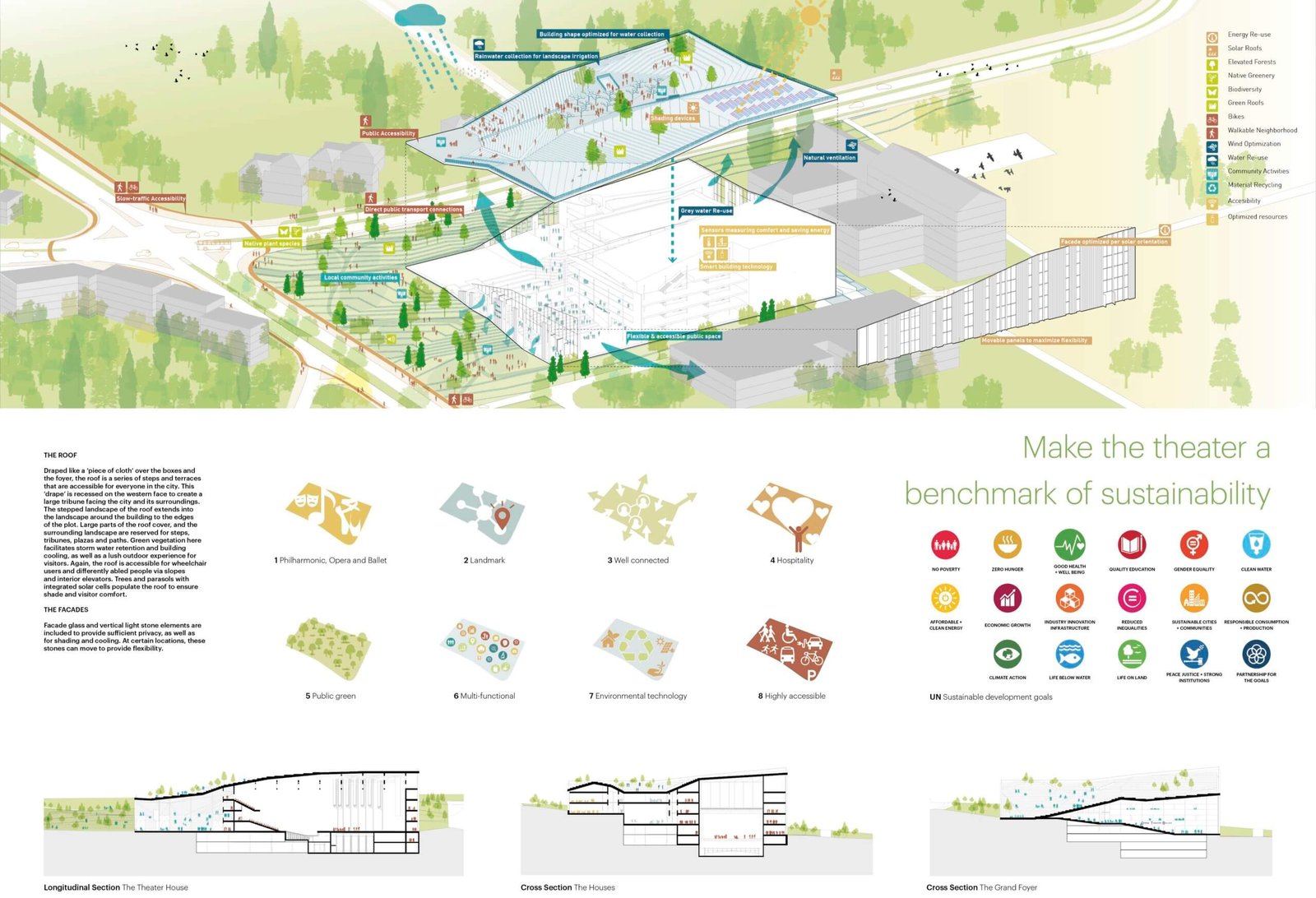
Draped like a continuous piece of cloth over the three programmatic houses and the central foyer, the roof unfolds as a series of accessible steps and terraces open to everyone in the city. On the western side, the drape is recessed to form a large urban tribune facing Prishtina and its wider landscape. The roof extends beyond the building envelope, merging seamlessly with the surrounding site and dissolving the boundary between architecture and ground.
Large portions of the roofscape are dedicated to steps, tribunes, plazas, and paths, transforming the building into an elevated public realm. Integrated green areas support stormwater retention and passive cooling while offering a lush outdoor environment. The entire roof is fully accessible to wheelchair users and people with differing abilities through a combination of gentle slopes and interior elevators.
Trees and parasols equipped with integrated solar cells provide shade and visitor comfort while contributing to the building’s environmental performance. The roof thus functions simultaneously as public space, climatic infrastructure, and cultural landscape.
The facades are composed as a layered system combining glass surfaces with vertical light stone elements. This strategy balances transparency with privacy, while providing shading and thermal control. At selected locations, the stone elements are operable, allowing the envelope to adapt to environmental conditions and programmatic needs. Together, solidity and openness form a dynamic interface between the interior performance spaces and the public life unfolding outside.